

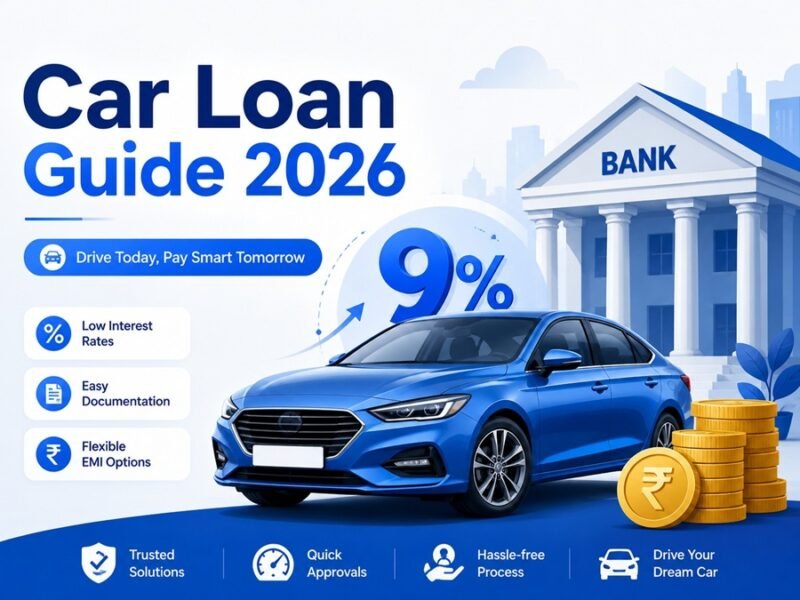
Buying a car is a big dream for most Indians. But with car prices rising every year, paying the full amount upfront is not always possible. That is where a Car Loan helps.
A car loan lets you drive your dream car today and pay for it in easy monthly instalments (EMI) over time. In 2026, banks and NBFCs are offering competitive interest rates — making it a smart time to finance your vehicle.
In this complete guide, you will learn everything about car loans — interest rates, eligibility, how EMI is calculated, documents needed, and a step-by-step process to apply online. Whether you are buying a new car or a used one, this guide covers it all.
What is a Car Loan? A Car Loan is a secured loan where a bank or financial institution lends you money to buy a new or used car. You repay the amount in fixed monthly instalments (EMI) over a chosen tenure, typically 1 to 7 years. The car itself acts as collateral until the loan is fully repaid.
What is a Car Loan?
A Car Loan (also called an Auto Loan or Vehicle Loan) is a type of secured loan that helps you purchase a car — new or used — without paying the entire price upfront.
You borrow money from a bank or NBFC and repay it in Equated Monthly Instalments (EMI) over a period you choose. The car is kept as security (collateral) with the lender. Once you repay the full loan, the car’s ownership is transferred completely to you.
Car loans are available for:
- New Cars (from dealers)
- Used / Pre-owned Cars
- Electric Vehicles (EVs)
- Commercial Vehicles
How Does a Car Loan Work?
Here is a simple breakdown of the car loan process:
- You choose a car — new or used, from a dealer or private seller.
- You apply for a loan — at a bank, NBFC, or the car dealer’s financing arm.
- The lender assesses your profile — income, CIBIL score, employment type.
- Loan is approved — lender decides the amount, interest rate, and tenure.
- Funds are disbursed — directly to the car dealer (not to you personally).
- You repay via EMI — fixed monthly payment including principal + interest.
- Loan closure — after final payment, the bank removes the hypothecation from the RC book.
Types of Car Loans
| Loan Type | Description |
|---|---|
| New Car Loan | For purchasing brand-new vehicles from authorised dealers |
| Used / Pre-owned Car Loan | For buying second-hand cars; slightly higher interest rates |
| Electric Vehicle (EV) Loan | Special schemes with lower rates for EVs; available in most banks |
| Car Loan Balance Transfer | Transfer existing car loan to another lender for a lower rate |
| Top-Up Car Loan | Additional loan over existing car loan for other needs |
| Car Loan Against RC | Loan against an already owned vehicle’s registration certificate |
| Dealer Finance | Arranged through the car dealership; partnered with banks/NBFCs |
Car Loan Eligibility Criteria
Eligibility varies slightly by lender, but here are the general criteria:
For Salaried Individuals
| Criteria | Requirement |
|---|---|
| Age | 21 to 60 years |
| Minimum Income | ₹20,000–₹25,000 per month (net take-home) |
| Employment | Minimum 1–2 years in current job; 2+ years total work experience |
| CIBIL Score | 700 and above (750+ preferred for best rates) |
| Employment Type | Government, PSU, MNC, or reputed private company |
For Self-Employed Individuals
| Criteria | Requirement |
|---|---|
| Age | 25 to 65 years |
| Minimum Annual Income | ₹2.5 lakh to ₹3 lakh (as per ITR) |
| Business Stability | Minimum 2 years in current business |
| CIBIL Score | 700 and above |
| ITR Filing | Last 2 years ITR required |
Car Loan Interest Rates in 2026
Interest rates differ based on the lender, car type, loan amount, and borrower’s credit profile.
New Car Loan Interest Rates (2026)
| Lender | Interest Rate (p.a.) | Processing Fee | Max Tenure |
|---|---|---|---|
| SBI Car Loan | 8.75% – 9.75% | Nil to ₹3,500 | 7 years |
| HDFC Bank | 8.80% – 10.50% | Up to ₹5,000 | 7 years |
| ICICI Bank | 8.90% – 10.75% | Up to ₹5,000 | 7 years |
| Axis Bank | 8.75% – 11.00% | Up to ₹5,500 | 7 years |
| Bank of Baroda | 8.70% – 10.25% | Up to ₹2,500 | 7 years |
| Kotak Mahindra Bank | 8.99% – 13.00% | Up to ₹5,000 | 5 years |
| Tata Capital | 9.00% – 14.00% | Up to ₹5,000 | 5 years |
Used Car Loan Interest Rates (2026)
| Lender | Interest Rate (p.a.) | Max Tenure |
|---|---|---|
| SBI Used Car Loan | 10.75% – 13.00% | 5 years |
| HDFC Bank | 11.00% – 14.50% | 5 years |
| ICICI Bank | 10.99% – 15.00% | 5 years |
| Axis Bank | 11.50% – 15.00% | 5 years |
Note: Rates are indicative and subject to change. Check the official bank website for latest rates before applying.
What Affects Your Car Loan Interest Rate?
- Your CIBIL score (higher score = lower rate)
- Type of car (new vs used; EV vs petrol/diesel)
- Loan amount and tenure
- Your income and employment stability
- Down payment percentage
- Relationship with the bank (existing customer may get better rates)
Car Loan EMI Calculator — Formula & Examples
What is EMI?
EMI stands for Equated Monthly Instalment. It is the fixed amount you pay every month to the lender, covering both the principal and interest.
EMI Formula
EMI = P × R × (1 + R)^N / [(1 + R)^N − 1]
Where:
- P = Principal loan amount
- R = Monthly interest rate = Annual Rate ÷ 12 ÷ 100
- N = Loan tenure in months
Worked Example
Loan Amount (P): ₹8,00,000 Annual Interest Rate: 9.00% Monthly Rate (R): 9 ÷ 12 ÷ 100 = 0.0075 Tenure (N): 60 months (5 years)
EMI = 8,00,000 × 0.0075 × (1.0075)^60 / [(1.0075)^60 − 1] EMI = 8,00,000 × 0.0075 × 1.5657 / [1.5657 − 1] EMI = 8,00,000 × 0.011742 / 0.5657 EMI ≈ ₹16,607 per month
Total Amount Paid = ₹16,607 × 60 = ₹9,96,420 Total Interest Paid = ₹9,96,420 − ₹8,00,000 = ₹1,96,420
EMI Table at 9.00% p.a. — Different Loan Amounts & Tenures
| Loan Amount | 3 Years (36 months) | 5 Years (60 months) | 7 Years (84 months) |
|---|---|---|---|
| ₹3,00,000 | ₹9,540 | ₹6,228 | ₹4,687 |
| ₹5,00,000 | ₹15,900 | ₹10,380 | ₹7,812 |
| ₹8,00,000 | ₹25,440 | ₹16,607 | ₹12,499 |
| ₹10,00,000 | ₹31,800 | ₹20,758 | ₹15,624 |
| ₹15,00,000 | ₹47,700 | ₹31,137 | ₹23,436 |
| ₹20,00,000 | ₹63,601 | ₹41,516 | ₹31,248 |
EMI Table — ₹8 Lakh Loan at Different Interest Rates (5-Year Tenure)
| Interest Rate | Monthly EMI | Total Payment | Total Interest |
|---|---|---|---|
| 8.75% | ₹16,468 | ₹9,88,080 | ₹1,88,080 |
| 9.00% | ₹16,607 | ₹9,96,420 | ₹1,96,420 |
| 9.50% | ₹16,888 | ₹10,13,280 | ₹2,13,280 |
| 10.00% | ₹17,005 | ₹10,20,300 | ₹2,20,300 |
| 10.50% | ₹17,295 | ₹10,37,700 | ₹2,37,700 |
| 11.00% | ₹17,587 | ₹10,55,220 | ₹2,55,220 |
Factors That Affect Your EMI
- Higher loan amount → Higher EMI
- Longer tenure → Lower EMI but higher total interest paid
- Higher interest rate → Higher EMI
- Larger down payment → Lower loan amount → Lower EMI
Benefits of Car Loan
- Own your dream car without waiting years to save the full amount
- Easy EMIs spread the cost over 1 to 7 years
- Low interest rates compared to personal loans (car is used as security)
- 100% financing available on select models with good credit profile
- Tax benefits for self-employed (interest deductible as business expense)
- Builds credit history — timely repayment improves CIBIL score
- Flexible repayment options — choose tenure that fits your budget
- Pre-approved offers for existing bank customers
Features of Car Loan
| Feature | Details |
|---|---|
| Loan Amount | Up to 85%–100% of car’s on-road price |
| Tenure | 1 year to 7 years |
| Interest Rate | 8.70% to 15.00% p.a. (varies by lender & profile) |
| Processing Fee | ₹0 to ₹5,500 (one-time) |
| Prepayment | Allowed (charges may apply in 1st year) |
| Foreclosure | Allowed after 6–12 EMIs (check with lender) |
| Collateral | The car itself (hypothecated to lender) |
| Disbursal Time | 24–72 hours (online); 2–5 days (offline) |
| Insurance | Comprehensive car insurance mandatory |
Documents Required for Car Loan
Salaried Employees
| Document Type | Examples |
|---|---|
| Identity Proof | Aadhaar Card, PAN Card, Passport, Voter ID |
| Address Proof | Aadhaar, Utility Bill, Passport, Rental Agreement |
| Income Proof | Last 3 months salary slips, Form 16 |
| Bank Statements | Last 6 months bank statements |
| Employment Proof | Offer letter / Employee ID card |
| Car Documents | Proforma Invoice from dealer |
| Photograph | 2 recent passport-size photos |
Self-Employed Individuals
| Document Type | Examples |
|---|---|
| Identity & Address Proof | Aadhaar, PAN, Passport |
| Income Proof | Last 2 years ITR with computation |
| Financial Statements | Last 2 years P&L, Balance Sheet (CA certified) |
| Bank Statements | Last 12 months business account statements |
| Business Proof | GST Certificate, Shop Act Licence, Partnership Deed |
| Car Documents | Proforma Invoice from dealer |
Charges and Fees
| Charge Type | Typical Amount |
|---|---|
| Processing Fee | ₹0 – ₹5,500 (one-time, non-refundable) |
| Prepayment / Foreclosure | 0% – 6% of outstanding principal |
| Late Payment Penalty | 1% – 3% per month on overdue amount |
| Cheque / ECS Bounce | ₹300 – ₹750 per instance |
| Duplicate NOC / RC Endorsement | ₹200 – ₹500 |
| Loan Cancellation | ₹500 – ₹2,000 (post disbursal) |
| Stamp Duty | As per state government norms |
Step-by-Step: How to Apply for a Car Loan
Online Application
- Compare lenders — Use an aggregator or bank websites to compare rates and offers.
- Check eligibility — Use the bank’s online eligibility calculator.
- Check your CIBIL score — Aim for 700+ before applying.
- Visit the lender’s website or app — Go to the Loans → Car Loan section.
- Fill the application form — Personal details, income, car details.
- Upload documents — Identity proof, income proof, bank statements.
- Get an offer — The bank generates a loan offer with rate and EMI.
- Accept and sign digitally — e-sign via Aadhaar OTP or digital signature.
- Disbursal — Funds sent directly to the car dealer within 24–72 hours.
- Collect your car — Once the dealer confirms payment, take delivery!
Offline / Dealer Finance Application
- Visit a bank branch or the dealership’s finance desk.
- Get the proforma invoice for the car.
- Fill the loan application form manually.
- Submit physical copies of documents.
- Wait for verification and approval (2–5 working days).
- Sign the loan agreement.
- Bank pays the dealer directly.
Advantages and Disadvantages of Car Loan
Advantages
- Immediate car ownership without full upfront payment
- Secured loan means lower interest than unsecured personal loan
- Builds and improves your CIBIL credit score if repaid on time
- Long repayment tenure (up to 7 years) keeps EMIs manageable
- Widely available — banks, NBFCs, and dealer finance desks
- Prepayment option to close early and save on interest
Disadvantages
- Car depreciates in value while you still owe money
- Total cost of car increases due to interest payments
- Missing EMIs can damage your CIBIL score significantly
- Car is hypothecated — you cannot sell it without NOC
- High processing fees in some banks/NBFCs
- Used car loans have higher interest rates and stricter terms
Tips to Get the Best Car Loan Deal
- Maintain a CIBIL score of 750+ — You qualify for the lowest rates.
- Make a larger down payment — 20%–30% down reduces loan amount and EMI.
- Negotiate processing fees — Many banks waive processing fees during festive offers.
- Choose a shorter tenure — Saves significant interest over the loan period.
- Compare at least 3–4 lenders before finalising.
- Apply as an existing customer — Banks offer preferential rates to existing account holders.
- Check for manufacturer finance schemes — Maruti, Hyundai, Tata, and others run zero or low-interest schemes during festive periods.
- Avoid multiple loan applications at once — Each application triggers a hard inquiry on your CIBIL report.
Common Mistakes to Avoid
- Not checking your CIBIL score before applying — rejection hurts your score
- Choosing the longest tenure just for a lower EMI (you end up paying much more interest)
- Ignoring the total cost of the loan (EMI × months vs just the interest rate)
- Not reading the fine print on prepayment charges
- Skipping a comparison of processing fees — these add to your total cost
- Financing 100% of the car value — always try to put down at least 10–20%
- Missing or delaying EMI payments — damages credit score and attracts penalties
Car Loan vs Personal Loan for Car Purchase
If you do not want to hypothecate your car, some people consider a personal loan for car purchase. Here is how they compare:
| Feature | Car Loan | Personal Loan |
|---|---|---|
| Interest Rate | 8.70% – 15.00% | 10.50% – 24.00% |
| Loan Amount | Up to 100% of car value | Based on income/credit |
| Tenure | Up to 7 years | Up to 5 years |
| Collateral | Car (hypothecated) | None (unsecured) |
| Processing | Faster (car as security) | Quick but higher rate |
| Tax Benefit (Self-Employed) | Interest deductible | Not deductible |
| Car Ownership | Hypothecated till repaid | Full ownership immediately |
| Best For | Planned car purchase | Urgent need / no hypothecation |
Verdict: Car loan is almost always better for buying a car. Lower rates, longer tenure, and possible tax benefits make it the smarter choice.
Latest RBI Guidelines on Car Loans (2026)
The Reserve Bank of India regulates lending practices. Key points applicable to car loans:
- Fair Lending Practices: Banks must disclose the Annual Percentage Rate (APR) — the true cost of borrowing — not just the flat interest rate.
- Prepayment Rules: RBI mandates that floating rate car loans (individual borrowers) must not carry prepayment charges. Fixed-rate loans may have charges — verify before signing.
- Repo Rate Impact: Car loan rates are often linked to the bank’s repo rate-based MCLR/EBR. When RBI cuts the repo rate, floating rate car loan EMIs decrease.
- CIBIL Score Access: Borrowers have the right to know the reason for loan rejection. You can request your CIBIL report for free once a year from CIBIL.
- Hypothecation Rules: As per MoRTH (Ministry of Road Transport and Highways) rules, the lender’s name is recorded in the vehicle’s RC (Registration Certificate) until full loan repayment.
- Recovery Agents: Banks cannot use coercive methods for EMI recovery. File a complaint with the RBI Ombudsman if harassed.
Frequently Asked Questions (FAQs)
Q1. What is the minimum CIBIL score required for a car loan?
Most banks require a minimum CIBIL score of 700. However, a score of 750 or above gives you access to the best (lowest) interest rates and faster approvals. Some NBFCs may approve loans for scores below 700 but at higher rates.
Q2. Can I get a 100% car loan (zero down payment)?
Yes, some banks and NBFCs offer up to 100% financing on the ex-showroom price, especially for customers with a high CIBIL score and strong income. However, on-road costs like insurance, registration, and accessories are typically not included and need to be paid separately.
Q3. What is the maximum tenure for a car loan?
Most banks offer car loans for up to 7 years (84 months). Some NBFCs may go up to 8 years. Longer tenure means lower EMI but more total interest paid overall.
Q4. Is it better to choose a shorter or longer tenure?
A shorter tenure means higher EMI but lower total interest. A longer tenure gives lower EMI but you end up paying significantly more interest. If you can afford it, a shorter tenure (3–5 years) saves more money overall.
Q5. What happens if I miss a car loan EMI?
Missing an EMI leads to a late payment penalty (1%–3% per month on overdue). More importantly, it is reported to CIBIL and lowers your credit score. Repeated defaults can lead to the bank repossessing your car. Always contact your bank in advance if you face financial difficulty.
Q6. Can I prepay or foreclose my car loan early?
Yes. Most banks allow prepayment after 6–12 EMIs. For floating-rate loans, RBI guidelines prohibit prepayment charges for individual borrowers. For fixed-rate loans, a foreclosure charge of 2%–6% on outstanding principal may apply.
Q7. Can I get a car loan for a used/second-hand car?
Yes. Most major banks and NBFCs offer used car loans. Interest rates are slightly higher (10.75%–15%) than new car loans, and the maximum tenure is usually 5 years. The car’s age also matters — most banks won’t finance cars older than 10 years.
Q8. What is the difference between flat rate and reducing balance rate for car loans?
A flat rate calculates interest on the original principal throughout the tenure. A reducing balance rate calculates interest on the outstanding principal, which reduces each month as you repay. Reducing balance is more borrower-friendly — most banks use this method. Always ask which method your lender uses.
Q9. Do I get tax benefits on a car loan?
For salaried individuals, there is no direct income tax deduction on car loan interest. For self-employed professionals or business owners, if the car is used for business purposes, the interest and depreciation can be claimed as a business expense under Income Tax rules.
Q10. How long does car loan approval take?
With complete documents and a good CIBIL score, pre-approved or online car loan approvals can happen within a few hours to 24 hours. Standard applications take 2–5 working days. Dealer-arranged finance is usually faster since the bank and dealer have a pre-existing relationship.
Final Verdict
A Car Loan in 2026 is more accessible than ever. With competitive interest rates starting from around 8.70%, flexible tenure up to 7 years, and digital applications that take just minutes, owning your dream car has never been easier.
The key is to plan smart:
- Maintain a strong CIBIL score (750+)
- Compare at least 3–4 lenders before applying
- Choose a down payment of 20%+ to reduce your loan burden
- Pick a tenure you are comfortable with — not just the lowest EMI option
Whether you are buying a new hatchback, a premium SUV, or an electric vehicle, a car loan is your best financing tool when used wisely.
Want more guides on loans, finance, and smart money decisions? Visit APZO Media — your trusted destination for practical, accurate, and up-to-date financial content. We help you make better financial choices every day.











Leave a Reply